Assumptions, a refresher and some definitions
This week there are certain assumptions that must be accepted to simplify the training delivery.
Unless you are clearly told otherwise assume:
- The kick is gas, and we are using water based mud
- The kick does not enter the drill string and is one bubble starting at the bottom of the hole
- The bit is on bottom
- The entire BHA is collars
- Drill pipe and heviwate pipe have the same OD
- There is no float in the string
- Tide, vessel motion, crane operations, heave do not affect subsea examples – obviously they will have an impact and must be managed correctly – how do they impact well monitoring?
A quick reminder here that this week is not about the maths – most question answers have a range. It’s important you get the well control correct… not the absolute arithmetical answer.
Except…
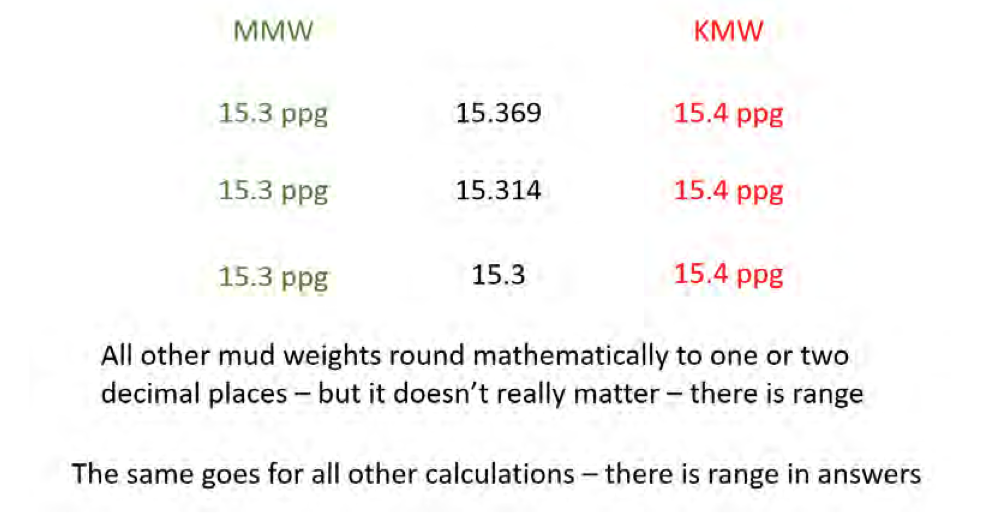
Kill Mud Weight – one decimal place rounded UP – every time
Maximum mud weight – one decimal AS CALCULATED – every time
Everything else round mathematically.
Well control understanding revolves around hydrostatic pressure and the U-tube principle. A good grasp of the hydrostatic pressure formula and its variations will go a long way in helping with your understanding of well control. The U-tube principle we simply must accept as we do not have the time available to conduct enough experiments to prove it. More on that later.
As with all formulas the important bit is not the words in the formula but the bit in brackets – the units – so stripping away the words for Hydrostatic Pressure (formula 1 on the IWCF formula sheet) we get:
You can work out any pressure if you know the mud density in ppg and the true vertical depth in ft. Using basic algebra, we can re-arrange this formula to get two variations on it namely:
and
There is a relationship in a well between the pressure at the bottom of the well, the mud density in the well and the true vertical height of that mud column as shown below:
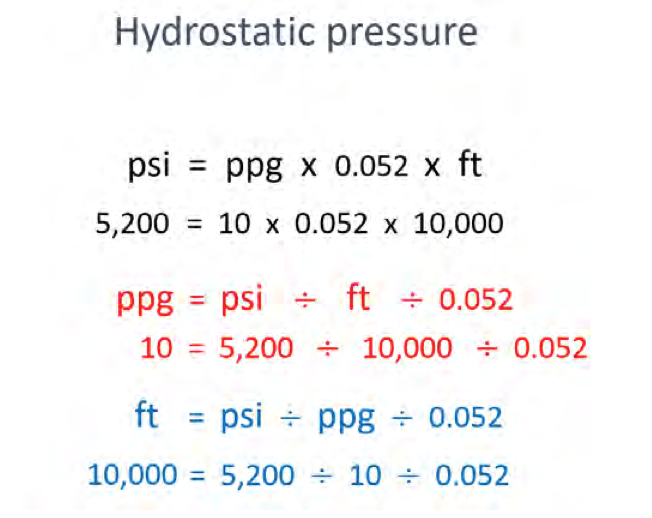
To work out pressure you multiply and that can be done in any order – for the two variations you must start with PRESSURE the divide by DENSITY or DEPTH the divide by the CONSTANT to get:

That was the refresher by the way.
And so, to some definitions for the week.
- Porosity is the space between grains of rock where formation fluids are stored. Expressed as a percentage.
- Permeability is how easily formation fluids can flow between the grains of rock. Expressed as Darcy’s or millidarcies.
- Primary well control is when hydrostatic pressure is greater than or equal to formation pressure.
- Secondary well control is the use of the BOP stack in combination with the fluid hydrostatic.
- Tertiary well control is used to bring a well back under control when both primary and secondary well control have been lost. May require intervention by specialist companies and techniques.
- Normal formation pressure is said to be the pressure exerted by a column of native water extending from surface to subsurface.
- Abnormal formation pressure is any formation pressure greater than normal.
- Subnormal formation pressure is any formation pressure less than normal.
This week we assume normal formation pressure has a gradient of